
Quick answer:
If your crown fell off, keep it, rinse it and put it somewhere safe. Chew on the other side, keep the tooth clean, and call your dentist the same day. Don’t glue it back yourself. Many crowns can be cemented back on, but only after the tooth underneath is checked for decay or a crack.
You bite into something sticky, and suddenly there is something hard rolling around on your tongue.
You spit it into your hand. It looks like a tooth, but hollow. Your tongue finds a small, rough stump where your crown used to be.
Most people’s first thought is: is this an emergency? Their second is: can I just push it back on?
The simple answer is that a crown falling off is rarely a medical emergency, and the crown itself can often be used again.
The more honest answer is that the crown is the easy part. What decides your options is the tooth underneath: why the crown let go, and whether that tooth is still healthy enough to hold it.
The crown is a clue. The tooth is the story.
Is it an emergency if my crown falls off?
Usually not, but it is urgent. A crown coming loose is a well-known complication. In a large review of fixed dental work, loss of retention was one of the three most common problems with single crowns, at about 2% (Goodacre et al., 2003).
Call the same day if you can. Here at JW Dentistry in La Mirada, serving nearby Whittier, La Habra and Buena Park, a crown that has come off is something we ask you to call about as an urgent visit, Monday to Thursday, 8 AM to 5 PM.
Go to an emergency room instead if you have facial swelling with a fever, trouble breathing or swallowing, or a serious injury. Emergency rooms usually cannot fix teeth, but they can handle those problems.

What should I do right after my crown falls off?
- Keep the crown. Take it out of your mouth so you don’t swallow it.
- Clean it gently. Rinse it with water and wipe off any food. Don’t scrub the inside with anything sharp.
- Store it safely. A small bag or container works. Bring it to your visit.
- Protect the tooth. Chew on the other side and avoid sticky, hard or very cold food.
- Keep the area clean. Brush the tooth gently, as you normally would.
- Call your dentist. Mention any pain, or if a piece of tooth came off with the crown.
The tooth may feel sensitive to cold air, drinks or sweets. That is common. Shaping a tooth for a crown exposes a huge number of tiny channels in the dentin, often estimated at one to two million, and those channels pass hot and cold through to the nerve (Yadav et al., 2014).
A sharp edge can be covered with a little dental wax from a pharmacy. An over-the-counter pain reliever, taken as the label directs, can help until you are seen.
My crown is loose but still on. Should I pull it out?
Don’t force it off. If it wiggles but stays in place, leave it there, avoid chewing on it and call. If it comes out on its own, keep it.
The bigger risk with a loose crown is what you can’t feel. In a study of bridges with one loose end, 82% of patients reported no discomfort, and 41% didn’t know it was loose. Yet half of those loose teeth already had decay underneath (Curtis et al., 2006).
No pain does not mean no problem.
Can I glue my crown back on myself?
Please don’t use superglue or any household adhesive. They are not made for the mouth, and they can make the crown much harder to clean and reseat properly.
Pharmacy “temporary crown cement” exists, but ask your dentist before using it. A crown that goes back on slightly out of place can change your bite, and it can seal food and bacteria against a tooth that may already have decay at its edge.
There is also the swallowing risk. A crown that was set at home and comes loose again, especially during sleep, is easy to swallow or breathe in.
My crown fell off. How long can I wait?
Days, not weeks. There is no exact deadline in the research, so treat this as “as soon as you reasonably can.”
Two things change while you wait. The trimmed tooth is unprotected and can chip or crack. And teeth that lose the contacts that hold them in place can shift; in one study of back teeth with no opposing tooth, 92% of people had teeth that had moved (Craddock et al., 2007). A tooth missing its crown is not exactly the same situation, but the principle is why a crown can stop fitting after a long delay.
In the bridge study above, the original work could be recemented 64% of the time (Curtis et al., 2006). Coming in early gives you the best chance of being in that group.
Why do crowns fall off?
Most loose crowns come back to a few causes:
- Decay at the edge. A crown can’t decay, but the tooth along its edge can, and decay was the most common complication on teeth supporting bridges in a major review (Goodacre et al., 2003).
- The shape of the tooth underneath. A crown holds on best to a tooth that is tall enough and not too tapered (Goodacre et al., 2001). In a 4-year study of molar crowns, shorter, more tapered teeth were more likely to lose their crowns (Ban et al., 2026).
- The cement and how it was bonded. In premolar crowns that came loose, how the tooth surface was prepared and which cement was used made a difference (Kabetani et al., 2022).
- Grinding and clenching. In matched groups of patients with bridges, people who grind or clench had more failures than people who don’t (Hawthan et al., 2022).
- A broken tooth. Sometimes the crown didn’t let go of the tooth; part of the tooth broke off inside it.
Sticky candy or chewing ice is often the moment a crown comes off, but it is usually the last straw rather than the whole reason.
The Biggest Difference: What’s Happening Under the Crown
Two people can lose a crown on the same day and walk out with very different plans.
If the cement simply wore out and the tooth is sound, the fix can be simple. If decay has crept under the edge, or the tooth has cracked, the crown can’t just go back on, no matter how good it looks.
That is why nobody can promise over the phone that your crown will go back on.
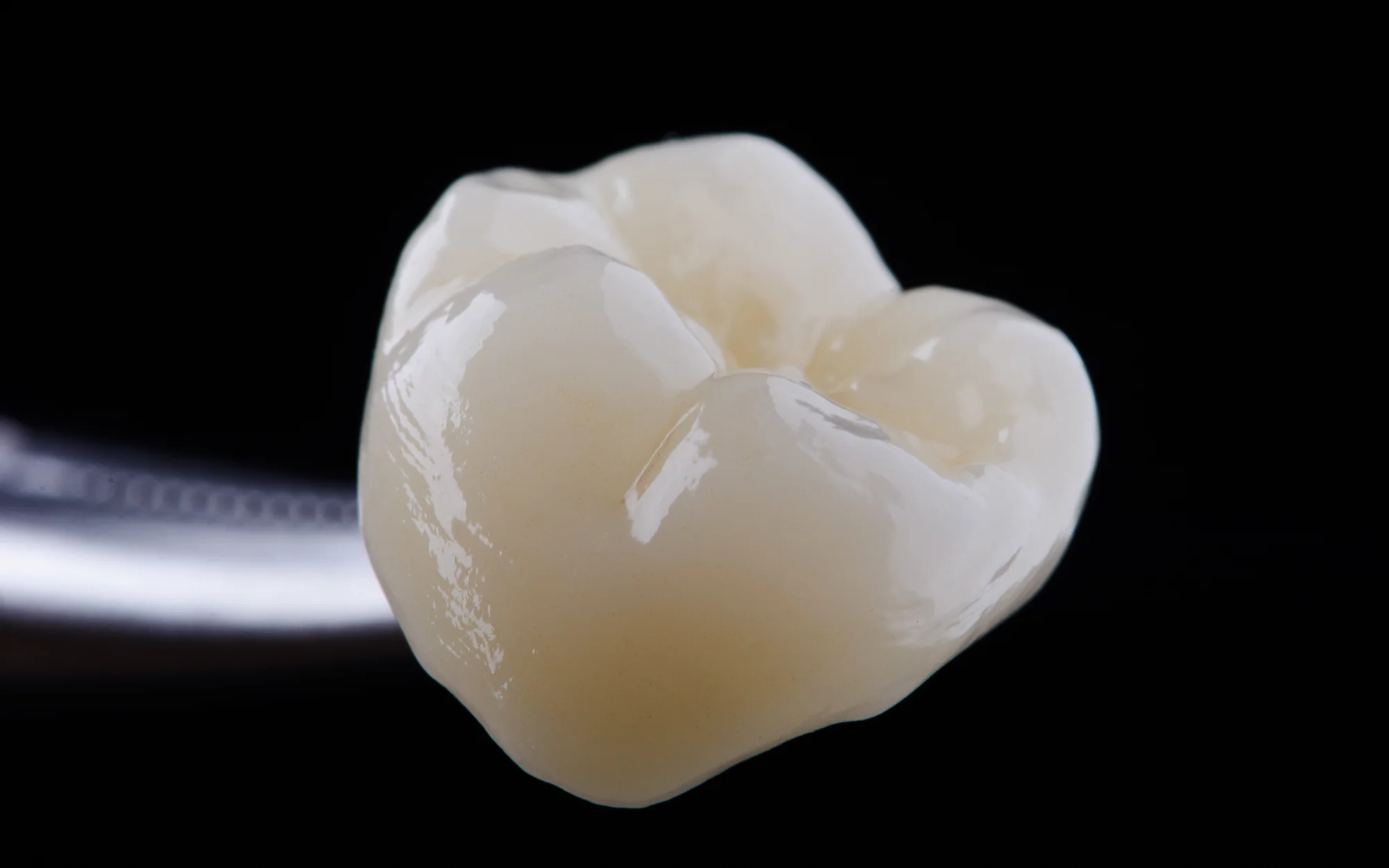
Can the same crown be put back on?
Often, yes, if the tooth is healthy and the crown is intact and still fits. If not, there are other ways forward. Here is how the main options compare.
| Option | When it usually fits | What to expect |
|---|---|---|
| Recement the same crown | The tooth is sound, with no decay or crack, and the crown is undamaged and seats fully | The tooth and crown are cleaned and the crown is cemented back |
| Repair the tooth, then a new crown | There is decay at the edge, or the old crown no longer fits | Decay is removed and the tooth rebuilt; a new porcelain crown usually takes more than one visit, with a temporary in between |
| Root canal, then a crown | Decay or a crack has reached the nerve | Root canal treatment first, then a crown to protect the tooth |
| Replace the tooth | Too little healthy tooth is left to hold a crown | The tooth is removed and replaced with a dental implant or a bridge |
You hear which of these applies to your tooth, and why, before anything starts.
What We Look at Before Recommending Recementing or a New Crown
- The tooth. Is there decay at the edge, a crack, or a missing piece?
- The x-ray. Digital x-rays show decay under the surface and the health of the root.
- The crown. Is it chipped or cracked, and does it still seat fully and evenly?
- Your bite. Does it feel even when you close, or does the crown hit first?
- Your habits. Grinding, clenching or chewing ice can shorten a crown’s life again.
- The crown’s history. Has this crown come off before?

If grinding is part of the story, a night guard may be suggested once the crown is back on, to take some of the force off it at night.
What if my temporary crown fell off?
This is common, and it is partly by design. Temporary crowns are set with cement meant to come off easily at your next visit. In lab testing, provisional cements held crowns less firmly than most permanent cements (Pinzón et al., 2009).
Still call soon. The temporary keeps the trimmed tooth comfortable and holds space for your final crown, so a quick recement usually keeps your plan on track.
What if it’s a crown on a dental implant?
An implant crown that feels loose is often a loose screw, not loose cement. Across studies of implant crowns, screw or abutment loosening happened in about 12.7% of crowns over five years (Jung et al., 2008).
It is usually fixable, but don’t keep chewing on it. A loose part can wear or break the more it moves.
What if I swallowed my crown?
Swallowed dental objects usually go into the stomach rather than the airway. In one review of cases, about 9 in 10 were swallowed rather than breathed in (Huh, 2022).
Breathing one in is the serious case. Crowns and other dental prosthetics were the most common item in reported dental aspirations, and removal usually needs a bronchoscopy (Araujo et al., 2022).
Coughing, wheezing or trouble breathing after losing a crown means get medical help right away.
If you feel fine, call your physician and your dentist for advice on what to do next.
Are there risks or limits to recementing a crown?
Yes, and it helps to know them going in.
- A recemented crown may not last as long. In one practice-based study, recemented crowns failed more often than crowns on their first cementation (Smales & Hawthorne, 2004). If the original cause, like a short tooth or grinding, is still there, it can come off again.
- Some problems only show once the crown is off. Decay or a crack under the crown can change the plan at the visit.
- Crowns have a life span. Reviews put five-year survival of single crowns at about 93% for all-porcelain and 96% for porcelain-fused-to-metal crowns (Pjetursson et al., 2007). An older crown that keeps coming loose may be near the end of its life.
How much does it cost to fix a crown that fell off?
It depends on which option your tooth needs, so an honest price comes after the exam.
What we can tell you now: new patients get an emergency exam and x-rays for $59. Any treatment, such as recementing a crown or making a new one, is priced separately and explained before it starts. Our dental crowns page explains what affects the cost of a new crown.
We work with most PPO plans and file your claims for you. Before treatment, ask for an estimate of your share; your plan decides what it pays. No insurance? Ask about our membership plan or financing with Cherry, with 0% APR plans for those who qualify.
Final Takeaways
- A crown that falls off is rarely a medical emergency, but it is worth a same-day call.
- Keep the crown, rinse it and bring it with you.
- Don’t glue it back yourself, and don’t force off a crown that is only wobbling.
- No pain doesn’t mean no decay; loose crowns often hide it.
- Whether the same crown goes back on depends on the tooth underneath.
- Temporary and implant crowns come loose for different reasons, and both are usually fixable.
- Trouble breathing after losing a crown needs medical help right away.
Lost a crown? Call (562) 947-2555 and tell the front desk what happened, or send us a message. Dr. Sohn will check the tooth, show you what he finds on the screen, and explain your options and their cost before anything starts.