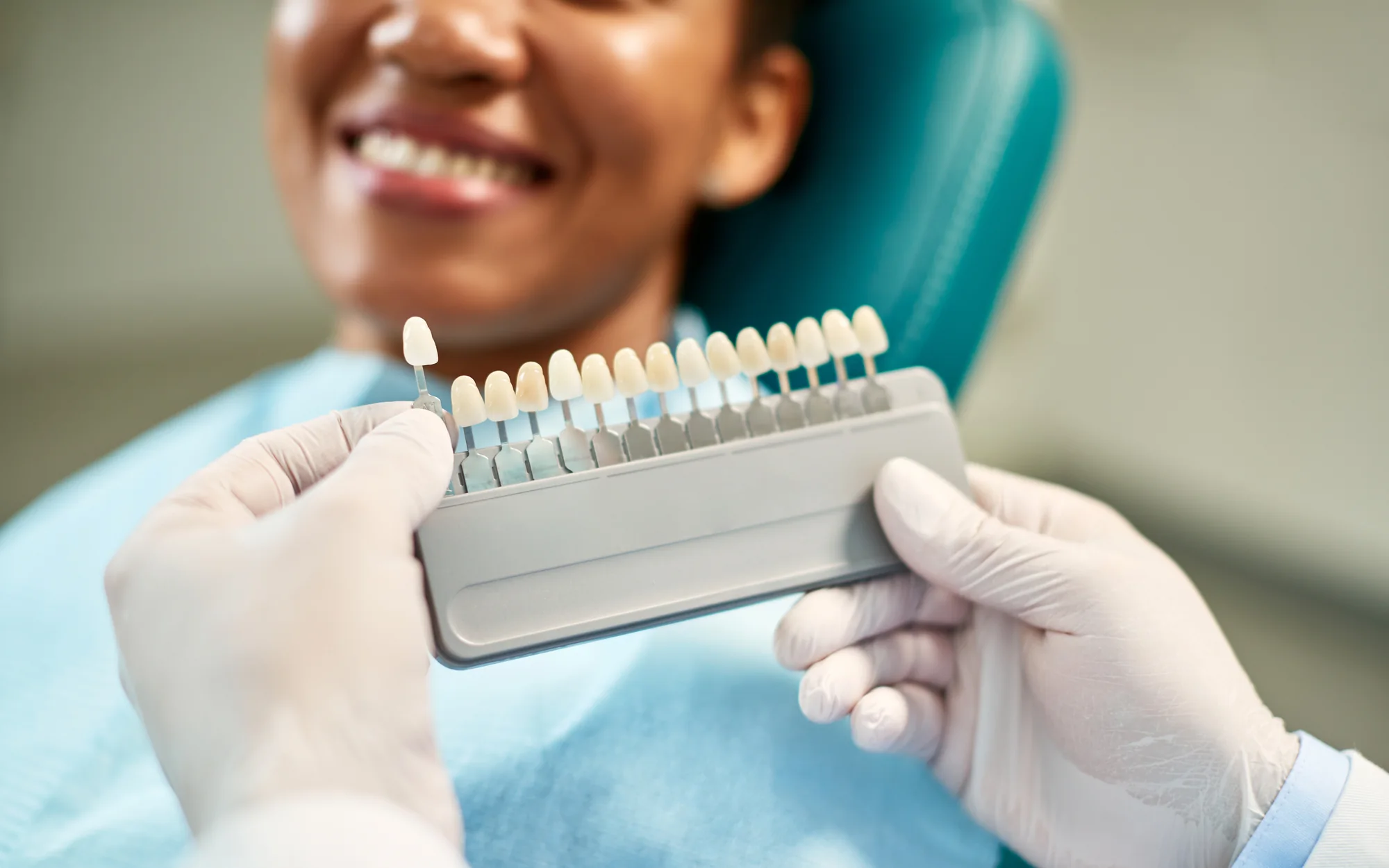
Quick answer:
Bonding is the quickest and least costly fix for small chips and gaps, but it stains and chips more over time. Porcelain veneers change the color and shape of healthy front teeth and last longer. Crowns cover the whole tooth and are for teeth that are broken, heavily filled or weakened, not just for looks.
You catch yourself in a photo and notice it again: the chipped edge, the small gap, the one tooth that’s a shade darker than the rest.
You start reading about fixes and quickly find three words that sound similar: bonding, veneers, crowns. Each seems to promise a better smile.
The simple answer is that all three can improve how a front tooth looks.
The more honest answer is that they are built for different problems. The right one depends less on what you want to change and more on how healthy the tooth is underneath, and how much of it you’re willing to give up.
The best cosmetic option is the one that fixes the problem with the least tooth removed.
What is the difference between bonding, veneers and crowns?
- Bonding is tooth-colored resin applied directly to the tooth and shaped by hand, usually in one visit.
- Porcelain veneers are thin, custom shells bonded to the front of the teeth. At JW Dentistry they are made in a lab from a digital scan, usually over two or three visits.
- Crowns cover the entire tooth, all the way around, and are made in a lab from a digital scan.
How much tooth each one takes is the biggest practical difference. In a lab study of front teeth, veneer preparations removed roughly 3% to 30% of the visible tooth structure, while full crowns removed about 63% to 72% (Edelhoff & Sorensen, 2002). Bonding often needs little or no shaping at all.
Veneers vs. crowns vs. bonding: how do they compare?
| Bonding | Porcelain veneers | Crowns | |
|---|---|---|---|
| Best for | Small chips, small gaps, uneven edges | Color, shape and minor alignment on healthy front teeth | Broken, heavily filled or weakened teeth |
| Tooth removed | Little or none | A thin layer of enamel | A layer all the way around |
| Visits | Usually one | Usually two or three | Usually two |
| Stain resistance | Can stain over time | Resists staining well | Resists staining well |
| Area cost per tooth | About $240–$630 | About $1,000–$2,750 | About $1,100–$3,000 |
Costs are California and Los Angeles-area averages from 2026 cost data, not our fees. Your fee is given after your exam, before any treatment.
When is bonding the right choice?
Bonding is a good fit for small, specific problems: a chipped corner, a narrow gap, a short or uneven edge. It is quick, it is the least costly of the three, and it can usually be repaired or added to later.
The trade-off is durability. Resin is softer than porcelain. In a large review of front-tooth composite restorations, fracture and appearance problems such as staining were the main reasons they eventually needed redoing (Demarco et al., 2015).
So bonding often needs touch-ups or polishing over the years, especially if you drink coffee, tea or red wine.
When are porcelain veneers the better option?
Porcelain veneers make sense when you want to change the color or shape of several healthy front teeth, cover stains whitening can’t fix, or close small gaps and even out edges.
They have a strong track record. In a review of porcelain laminate veneers, about 95.5% were still in place after 10 years (Alenezi et al., 2021). In an older clinical trial comparing veneer types, porcelain veneers had the best overall survival compared with direct and lab-made resin veneers (Meijering et al., 1998).
The trade-off: a thin layer of enamel is usually removed, which can’t be put back. If you choose veneers, you are choosing veneers for the long term.

When is a crown better than a veneer?
A crown is the right choice when the problem goes beyond the front surface:
- The tooth is badly broken or has a large filling
- It has had a root canal and is weak or dark
- It is cracked
- There isn’t enough healthy enamel for a veneer to bond to
Crowns are strong and long-lasting; reviews put about 93% to 96% of single crowns still in place at five years (Pjetursson et al., 2007). But using a crown on a healthy tooth just to change its look removes far more tooth than needed.
A crown is a repair first and a cosmetic choice second.
The Biggest Difference: How Much Tooth You Keep
Bonding adds to your tooth. Veneers replace a thin front layer. Crowns replace the whole outer shell.
Each step up gives more control over color, shape and strength, and each step up removes more natural tooth. Because enamel doesn’t grow back, it is usually wise to start with the most conservative option that will truly solve the problem.
Sometimes the best answer isn’t any of the three. Whitening, or straightening with Invisalign (see Invisalign vs. braces for adults), can change a smile without covering teeth at all.
What We Look at Before Recommending Veneers, Crowns or Bonding
- The health of each tooth. Decay, old fillings, cracks and root canals.
- How much enamel is left. Veneers and bonding need good enamel to bond to.
- Your bite. Edge-to-edge bites and grinding put extra stress on front teeth.
- Your gums. They should be healthy before cosmetic work.
- Your goals. A chip on one tooth is a different plan from a whole new smile.
- Whether whitening comes first. Veneers and bonding are matched to your teeth, so whitening is usually done before.
Here in La Mirada, Dr. Sohn checks your teeth and gums first and walks you through each option, including the one that removes the least tooth. For a bigger change, a smile makeover plan can combine several treatments.
What are the risks and limits of each?
- Bonding can chip and stain and may need touch-ups.
- Veneers usually involve removing enamel, so the decision isn’t easily undone. They can chip or come off, especially with grinding.
- Crowns remove the most tooth and can still get decay at the edge.
- None of them whitens. Resin and porcelain won’t change color with whitening gel later.
- Grinding shortens the life of all three. A night guard is often recommended if you grind.
Which is most affordable: bonding, veneers or crowns?
Bonding costs the least upfront. Veneers and crowns cost more per tooth but tend to last longer, so the yearly cost can be closer than it first appears.
Cosmetic treatment usually isn’t covered by insurance, though crowns that repair a damaged tooth often are partly covered. We work with most PPO plans and file your claims, and financing with Cherry is available to those who qualify.
Final Takeaways
- Bonding: quickest and least costly, best for small fixes, but stains and chips more.
- Veneers: change color and shape of healthy front teeth and last a long time.
- Crowns: for teeth that are broken, weak or heavily filled.
- Each step up removes more natural tooth, which can’t grow back.
- Whitening is usually done first, because none of the three changes color later.
- The right choice depends on the tooth’s health, your bite and your goals.
Thinking about changing your smile? Call (562) 947-2555 or request a visit. Dr. Sohn will look at your teeth, explain which options fit, and give you the fees before anything starts.